

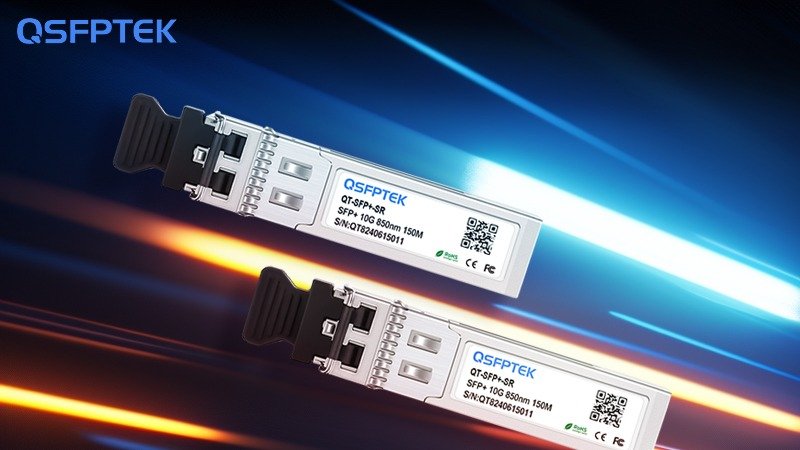
From racks in data centers to floors in enterprise buildings, 10G SFP+ SR optical modules, with their low cost and low power consumption, silently support the high-speed flow of massive amounts of data every day.
Among the many 10G SFP+ optical module models, the SR (Short Reach) type has become the preferred solution for short-distance network connections due to its excellent cost-effectiveness and performance.
Unlike LR modules suitable for 10km transmission or ER/ZR modules for ultra-long-distance transmission, SR modules are specifically designed for short-distance transmission of hundreds of meters, playing an irreplaceable role in scenarios such as data centers and enterprise LANs.
Core Features of 10GBASE-SR SFP+
The 10G SR SFP+ optical module complies with the 10GBASE-SR Ethernet specification and is designed specifically for short-distance data transmission.
Its maximum transmission distance reaches up to 400 meters, depending on the type of multimode fiber used.
This optical module uses an 850nm wavelength VCSEL (Vertical Cavity Surface Emitting Laser) as its light source.
VCSEL lasers are known for their low cost and high reliability, making them ideal for short-haul transmission over multimode fiber.
In terms of interfaces, 10G SFP+ SR optical modules typically utilize duplex LC connectors, enabling easy integration into existing network infrastructure.
Notably, SR optical modules typically consume less than 1 watt, making them more energy-efficient than long-haul optical modules. This is a significant advantage for large-scale data center deployments.
Why 10G SR SFP+ is the preferred choice for short-haul transmission
The primary advantage of 10GBASE-SR SFP+ optical modules in short-haul applications is their outstanding cost-effectiveness.
Not only is the module itself relatively inexpensive, but the accompanying multimode fiber cabling system is also less expensive than single-mode fiber, significantly reducing overall network deployment costs.
The low power consumption of SR optical modules is particularly valuable in large-scale deployments.
A typical SR module typically consumes less than 1 watt of power, while LR modules consume much more. This difference can significantly impact operational costs in data center environments where hundreds or even thousands of modules operate simultaneously.
10G SFP+ SR optical modules also offer the advantages of compact size and high port density.
The standard SFP+ form factor allows network equipment to provide more ports within a limited space, improving port density and overall utilization efficiency.
In addition, SR modules are highly compatible with mainstream network equipment brands and support hot-swappability, making installation and maintenance easier and effectively reducing network downtime.
Application Scenario: Where 10G SFP+ SR Utilizes Value
The most typical application scenario for 10G SFP+ SR optical modules is internal data center connectivity.
Whether connecting servers and switches within the same rack or interconnecting adjacent racks, SR modules provide a stable and reliable short-distance, high-speed data transmission solution.
In enterprise network environments, SR optical modules are widely used for LAN cabling within buildings.
If multimode fiber (typically orange or aqua) is already deployed within the building, SR modules are a cost-effective option.
10G SFP+ SR modules can also be used in storage area networks (SANs) and Fibre Channel applications, providing high-performance connectivity solutions in these scenarios.
SR modules also play a vital role in connecting wireless networks and baseband units, supporting the back-end connectivity required by 4G/LTE and 5G networks.
Selection Considerations: How to Properly Select and Use SR Optical Modules
When selecting a 10G SFP+ SR optical module, several key factors should be considered. Transmission distance is the primary factor—SR modules are best suited for connections under 400 meters.
For transmission distances exceeding 400 meters, LR or other long-reach modules should be considered.
The existing fiber type also directly influences module selection. If the network already has multimode fiber (typically orange or aqua), SR modules are the most suitable option.
If single-mode fiber (typically yellow) is already deployed, LR modules should be selected.
Budget considerations are also important. For short-distance applications, the total cost of an SR module plus multimode fiber is significantly lower than a LR module plus single-mode fiber combination.
It’s important to note that different multimode fiber types affect the actual transmission distance of the SR module:
When using OM3 fiber, the maximum transmission distance is 300 meters.
When using OM4 fiber, the transmission distance can reach 400 meters.
If using older OM1 or OM2 fiber, the transmission distance is significantly reduced to 33 meters or 82 meters.
Therefore, it’s crucial to confirm the fiber type before deployment.
Comparative Analysis: Differences between SR, LR, and LRM Modules
The core differences between 10G SFP+ SR and LR modules are reflected in several aspects. SR uses an 850nm VCSEL laser, while LR uses a 1310nm DFB laser.
Think of the VCSEL as a “floodlight” that illuminates a wide area, suitable for the large core of multimode fiber; the DFB laser, on the other hand, is like a “laser pointer” that can illuminate a long distance, suitable for the small core of single-mode fiber.
In terms of transmission distance, the SR module is limited to 400 meters, while the LR module reaches up to 10 kilometers. Regarding fiber type, the SR module works with multimode fiber, while the LR module requires single-mode fiber.
In terms of cost, the SR module and the accompanying multimode fiber system offer lower overall costs.
Compared to the LRM module, both the SR and LRM support multimode transmission, but each has its own unique characteristics.
On older OM1/OM2 fiber, the LRM module has a transmission distance of up to 220 meters, far exceeding the SR module’s 33 meters.
However, on OM3/OM4 fiber, the SR module’s transmission distance (300-400 meters) outperforms the LRM module’s 220 meters.
When choosing a module, if the transmission distance is less than 300 meters and OM3/OM4 fiber is used, the SR module is more suitable. If the transmission distance exceeds 33 meters on older OM1/OM2 fiber, the LRM module is a better choice.
Summary
According to actual application data, when using OM4 multimode fiber, the 10G SFP+ SR optical module can achieve a transmission distance of up to 400 meters, fully meeting the cabling requirements of most data centers and enterprise campuses.
For connections within a single rack or between adjacent racks, the 10G SR SFP+ optical module, with its low power consumption and high cost-performance, is an ideal choice for balancing performance and cost.
With the continuous advancement of network technology, the 10G SFP+ SR optical module continues to maintain steady growth in the global market, proving its irreplaceable role in specific application scenarios.